Social Anxiety vs. Generalized Anxiety in Young Adults: Why the Distinction Matters
By Lisa Long, Psy.D. | Licensed Forensic & Clinical Psychologist
Your daughter dreads group projects and avoids the dining hall. Your son can't stop worrying about everything—grades, money, his health, the future. Both are anxious. Both are struggling. But these are not the same problem, and treating them the same way is one reason so many young adults stay stuck.
The difference between social anxiety disorder and generalized anxiety disorder isn't academic hairsplitting. It determines which therapy techniques actually work, which medication strategies make sense, and—perhaps most importantly—which specific barriers are keeping your young adult from building the life they want.
Understanding this distinction is the first step toward getting them unstuck.
The Core Difference
Social anxiety disorder (SAD) centers on a specific fear: being judged, embarrassed, or rejected in social situations. The young adult with SAD isn't worried about everything—they're terrified of appearing anxious, boring, or incompetent in front of others. This leads to avoidance of social situations or enduring them with intense distress (Jefferies & Ungar, 2020; Walder et al., 2025).
Generalized anxiety disorder (GAD) is different. It's characterized by excessive, hard-to-control worry that isn't limited to any one situation. Health, finances, academics, family, career—the worry floats from topic to topic, rarely settling, rarely resolving. It persists for months and comes with physical symptoms like restlessness, muscle tension, and sleep problems (Rickels & Rynn, 2001; Crocq, 2017).
Here's a useful way to think about it: SAD is fear of people watching, while GAD is fear of everything falling apart.
Neuroimaging research supports this distinction. GAD involves an inefficient worry-based strategy for managing emotions, while SAD shows atypical processing of social threat and self-referential information—the brain is hypervigilant specifically about how others perceive the self (Blair & Blair, 2012).
How Each Disorder Shows Up in Daily Life
The differences aren't just theoretical. They shape how young adults interact with the world in distinct ways.
Research on college-aged populations found that young adults with SAD tend toward a socially avoidant, nonassertive interpersonal style—they withdraw, they don't speak up, they don't put themselves forward. Those with GAD show more "exploitable" tendencies—difficulty setting boundaries, over-accommodating others, saying yes when they mean no (Shin & Newman, 2019).
Both patterns create problems, but different ones. The socially avoidant young adult misses opportunities for connection and advancement. The boundary-challenged worrier burns out from overcommitment while never feeling secure.
The Real-World Stakes
Both disorders can derail the developmental tasks of young adulthood—building relationships, establishing careers, developing identity. But they do so through different mechanisms.
Social anxiety hits self-esteem and belonging hardest. SAD is a robust negative predictor of both self-esteem and life satisfaction in young adults (Nath & Sahai, 2024). Young people with social anxiety have fewer friends, smaller social networks, and more loneliness. They struggle in school and work settings that require social interaction—which is nearly all of them (Walder et al., 2025; De Lijster et al., 2018).
The cascade effect is significant. Social avoidance restricts exploration of roles, communities, and intimate relationships—the very contexts where young adults form identity and learn who they are (Walder et al., 2025; Jefferies & Ungar, 2020).
GAD hits academic and professional functioning hardest. Generalized anxiety is strongly associated with academic difficulties and perceived school problems, even without comorbidity. The constant worry consumes cognitive bandwidth that could go toward learning, creating, and producing (Kajastus et al., 2023). Young adults with GAD show lower role-emotional functioning and productivity (Comer et al., 2011).
Chronic worry also drives over-cautiousness. Intolerance of uncertainty makes it hard to make and commit to life choices—choosing a major, pursuing a relationship, taking a career risk (Counsell et al., 2017; Showraki et al., 2020).
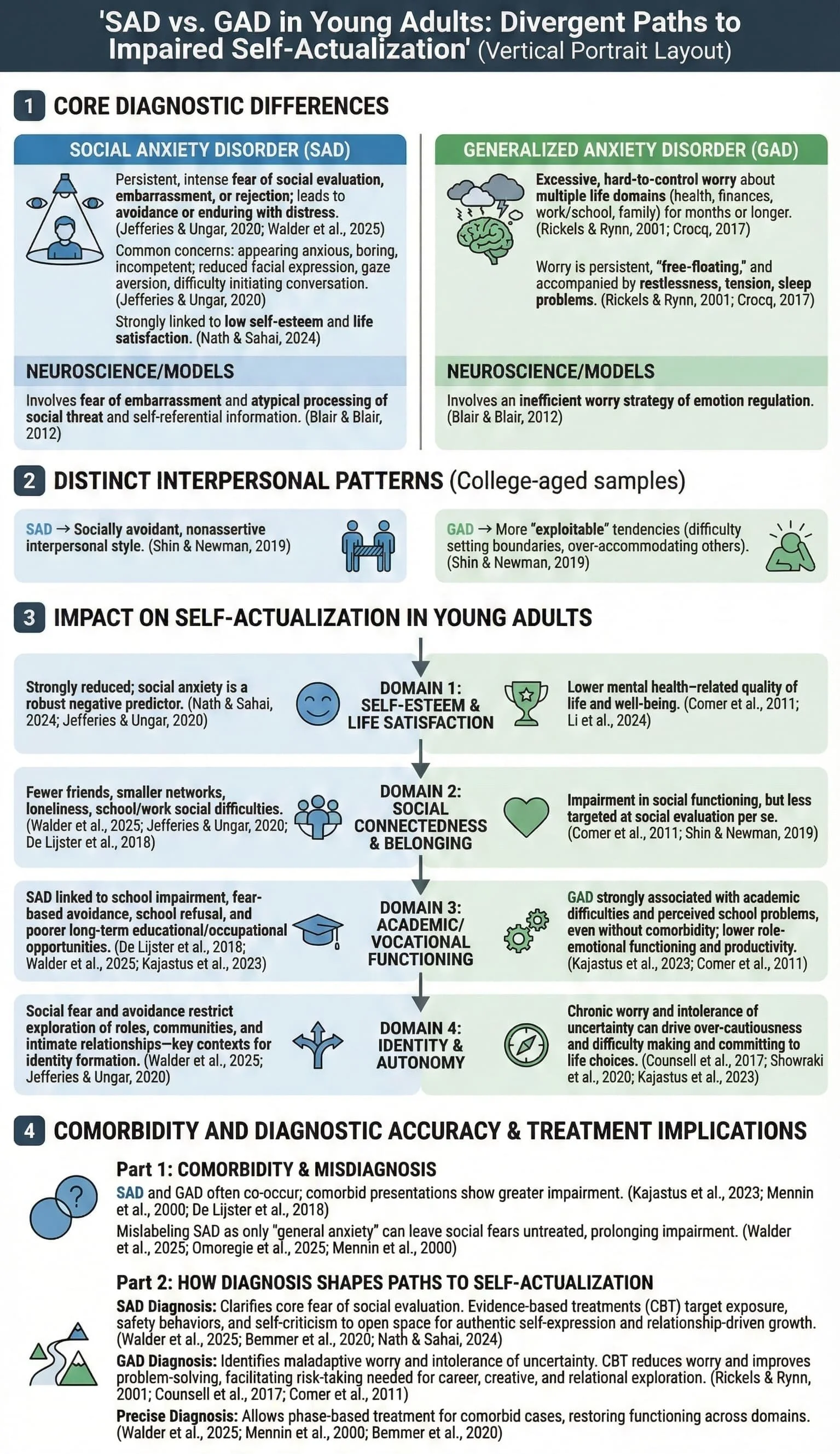
A visual breakdown of how SAD and GAD impact young adult development differently. (Source: Dr. Lisa Long, Psy.D.)
The Comorbidity Problem
Here's where diagnosis gets complicated: SAD and GAD frequently co-occur. When they do, impairment is greater than either disorder alone—these young adults show the most significant school and social difficulties (Kajastus et al., 2023; De Lijster et al., 2018).
Research reveals a diagnostic blind spot. When young adults self-report "anxiety," clinicians often default to a GAD label. But when assessments look at specific symptoms, cases distribute more evenly across SAD, GAD, and other anxiety disorders (Davies et al., 2021).
This matters because mislabeling SAD as "general anxiety" leaves social fears untreated. The young adult continues avoiding, continues missing opportunities, continues feeling isolated—even while their worry-focused treatment makes some progress (Walder et al., 2025; Omoregie et al., 2025).
Why Accurate Diagnosis Changes Everything
Effective treatment looks different for each disorder.
For social anxiety, evidence-based CBT targets exposure to feared social situations, safety behaviors (like avoiding eye contact or rehearsing every word), and self-criticism. Digital interventions have also proven effective. When treatment actually addresses social fear, young adults show improved social functioning, which supports better mood, relationships, and opportunities downstream (Walder et al., 2025; Bemmer et al., 2020).
For generalized anxiety, treatment focuses on worry patterns and intolerance of uncertainty as treatable patterns rather than realistic caution. CBT reduces worry, improves problem-solving, and builds tolerance for uncertainty—freeing up the energy and risk-tolerance needed for career exploration, creativity, and relational depth (Rickels & Rynn, 2001; Counsell et al., 2017).
For comorbid presentations, treatment often needs to be phased. Reduce disabling worry first, then systematically build social exposure and skills. When co-occurring SAD is missed, persistent social avoidance blunts treatment gains and maintains functional blocks in relationships and work (Mennin et al., 2000; Omoregie et al., 2025).
The Bottom Line
Social anxiety and generalized anxiety are both anxiety disorders, but they target different aspects of a young adult's life. SAD primarily constrains social exploration, intimacy, and belonging. GAD primarily disrupts cognitive bandwidth, academic performance, and decision-making. Both can substantially impede a young adult's path toward independence and self-actualization—especially when co-occurring or inaccurately diagnosed.
A comprehensive diagnostic evaluation distinguishes between these presentations (and identifies comorbidities), which directly shapes treatment selection and improves outcomes. For families watching a young adult struggle with anxiety, the question isn't just "are they anxious?"—it's "anxious about what, and how?"
About the Author
Dr. Lisa Long, Psy.D., is a licensed forensic and clinical psychologist providing comprehensive psychological evaluations nationwide via PSYPACT-authorized telehealth. She specializes in diagnostic clarity for young adults experiencing anxiety, depression, and failure-to-launch presentations. Learn more about clinical evaluations →
This article is for educational purposes and does not constitute a professional psychological opinion or diagnosis. If you're concerned about a young adult's functioning, a comprehensive evaluation can provide personalized diagnostic clarity and treatment recommendations.
Schedule a Clinical Evaluation or Consult
We specialize in providing diagnostic clarity for complex cases. For the fastest response (within 24 hours), please submit your request via our secure intake form:
Click Here to Complete the Nationwide Evaluation Request Form
Alternatively, if you prefer to email us, you may do so at david+referral@drlisalong.com. Please note that due to volume, email response times are significantly longer than form submissions.
You May Also Like
Failure to Launch Syndrome: A Complete Parent's Guide to Understanding and Helping Your Adult Child — When anxiety is part of a broader pattern of stalled independence, understanding the full picture changes everything.
The Misdiagnosis Crisis: Why Primary Care Misses Over 90% of Mental Health Conditions — Why "you have anxiety" from a 15-minute appointment often isn't the whole story—and what to do about it.
References
Blair, K., & Blair, R. (2012). A cognitive neuroscience approach to generalized anxiety disorder and social phobia. Emotion Review, 4(2), 133–138. https://doi.org/10.1177/1754073911430251
Comer, J., Blanco, C., Hasin, D., Liu, S., Grant, B., Turner, J., & Olfson, M. (2011). Health-related quality of life across the anxiety disorders: Results from the national epidemiologic survey on alcohol and related conditions (NESARC). The Journal of Clinical Psychiatry, 72(1), 43–50. https://doi.org/10.4088/jcp.09m05094blu
Counsell, A., Furtado, M., Iorio, C., Anand, L., Canzonieri, A., Fine, A., Fotinos, K., Epstein, I., & Katzman, M. (2017). Intolerance of uncertainty, social anxiety, and generalized anxiety: Differences by diagnosis and symptoms. Psychiatry Research, 252, 63–69. https://doi.org/10.1016/j.psychres.2017.02.046
Crocq, M. (2017). The history of generalized anxiety disorder as a diagnostic category. Dialogues in Clinical Neuroscience, 19(2), 107–116. https://doi.org/10.31887/dcns.2017.19.2/macrocq
Davies, M., Buckman, J., Adey, B., Armour, C., Bradley, J., Curzons, S., ... & Eley, T. (2021). Comparison of symptom-based versus self-reported diagnostic measures of anxiety and depression disorders in the GLAD and COPING cohorts. Journal of Anxiety Disorders, 85, 102491. https://doi.org/10.1016/j.janxdis.2021.102491
De Lijster, J., Dieleman, G., Utens, E., Dierckx, B., Wierenga, M., Verhulst, F., & Legerstee, J. (2018). Social and academic functioning in adolescents with anxiety disorders: A systematic review. Journal of Affective Disorders, 230, 108–117. https://doi.org/10.1016/j.jad.2018.01.008
Jefferies, P., & Ungar, M. (2020). Social anxiety in young people: A prevalence study in seven countries. PLoS ONE, 15(9). https://doi.org/10.1371/journal.pone.0239133
Kajastus, K., Haravuori, H., Kiviruusu, O., Marttunen, M., & Ranta, K. (2023). Associations of generalized anxiety and social anxiety with perceived difficulties in school in the adolescent general population. Journal of Adolescence. https://doi.org/10.1002/jad.12275
Mennin, D., Heimberg, R., & Jack, M. (2000). Comorbid generalized anxiety disorder in primary social phobia: Symptom severity, functional impairment, and treatment response. Journal of Anxiety Disorders, 14(4), 325–343. https://doi.org/10.1016/s0887-6185(00)00026-8
Nath, B., & Sahai, A. (2024). An assessment on impact of social anxiety on self esteem and life satisfaction among young adults. Advanced International Journal of Multidisciplinary Research. https://doi.org/10.62127/aijmr.2024.v02i02.1034
Omoregie, J., Pakshir, P., & Omoregie, E. (2025). Diagnostic clarity: Re-evaluating a clinical case for social anxiety disorder diagnosis in comorbid presentations. JORMA International Journal of Health and Social Sciences. https://doi.org/10.64074/pspwa225
Rickels, K., & Rynn, M. (2001). Overview and clinical presentation of generalized anxiety disorder. The Psychiatric Clinics of North America, 24(1), 1–17. https://doi.org/10.1016/s0193-953x(05)70203-3
Shin, K., & Newman, M. (2019). Self- and other-perceptions of interpersonal problems: Effects of generalized anxiety, social anxiety, and depression. Journal of Anxiety Disorders, 65, 1–10. https://doi.org/10.1016/j.janxdis.2019.04.005
Showraki, M., Showraki, T., & Brown, K. (2020). Generalized anxiety disorder: Revisited. Psychiatric Quarterly, 91, 905–914. https://doi.org/10.1007/s11126-020-09747-0
Walder, N., Frey, A., Berger, T., & Schmidt, S. (2025). Digital mental health interventions for the prevention and treatment of social anxiety disorder in children, adolescents, and young adults: Systematic review and meta-analysis of randomized controlled trials. Journal of Medical Internet Research, 27. https://doi.org/10.2196/67067